

What a guest journey review revealed at a boutique hotel in Slovenia
Project overview
→ Property: small boutique hotel with a restaurant and wellness facilities
→ Initial project: 3-day/2-night mystery guest stay and Guest Journey Review covering the entire journey – from the initial enquiry to post-stay communication. This was followed by a written report with findings and recommendations and an in-person debrief with the hotel owner and manager.
→ Follow-up: A few months later, I returned to help implement priority improvements, including service standards and communication guidelines, onboarding materials, team development, management support and sales training.
The hotel already had a strong concept and many elements of good hospitality in place. The review identified opportunities that were difficult to see from the inside – several of which later became the focus of our continued work together.
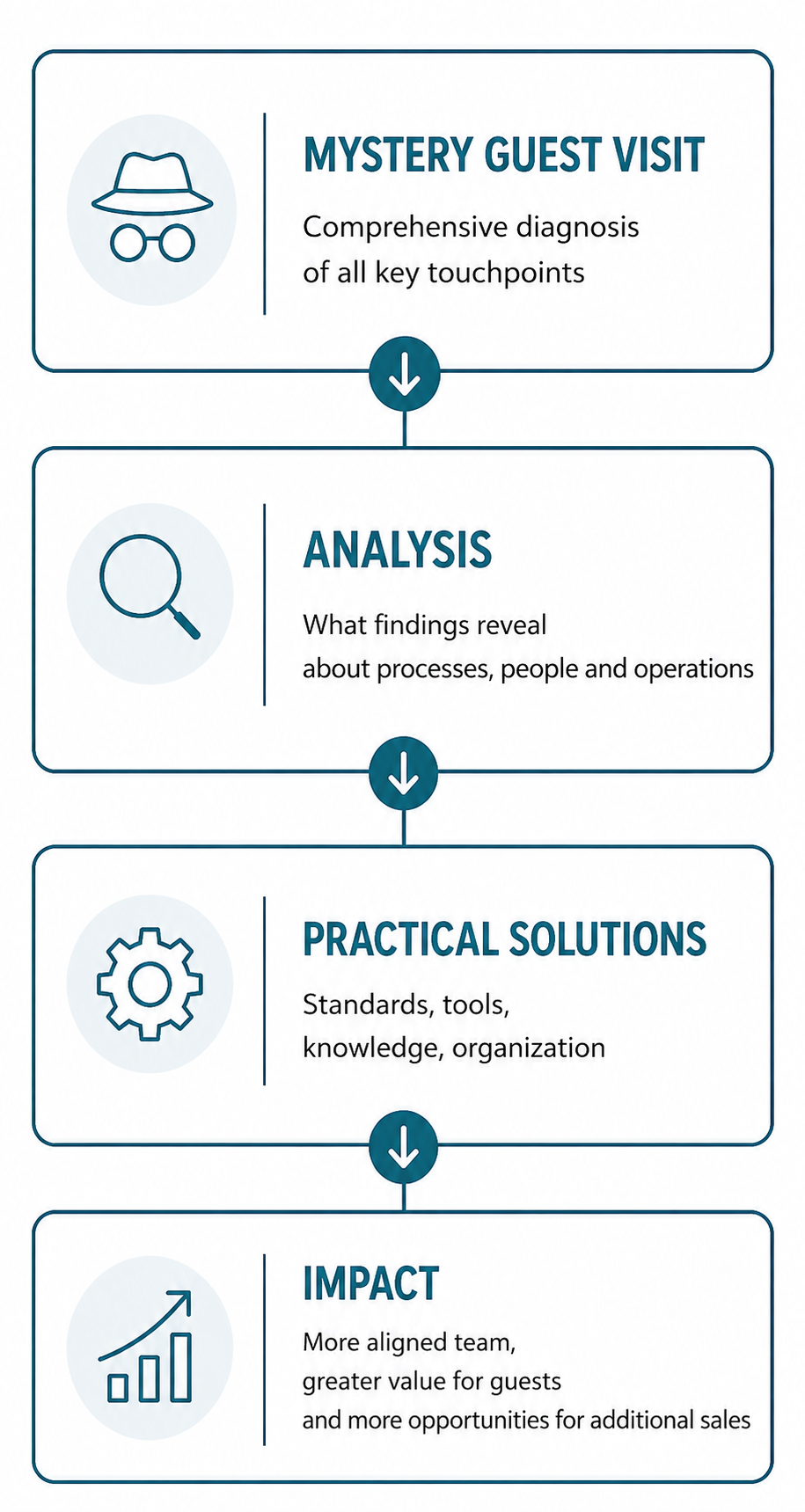
What the review revealed
A Guest Journey Review isn’t a walk around the hotel with a checklist to see whether the receptionist smiled or a breakfast plate was cleared quickly enough.
Those details matter, but the more useful question is: why did something happen?
I look for patterns: what the guest sees and feels, what might be happening behind the scenes, and what could be changed to improve their experience.
Here are a few examples from this hotel.
1 — Different answers depending on who the guest asked
What I noticed
Guests could receive different information or recommendations depending on which team member they spoke to.
What was behind it
The knowledge was there, but much of it remained in the heads of individual team members. There was no simple, consistent way to document it, share it or pass it on to new team members.
What we improved
We developed communication guidelines and onboarding materials, strengthened product knowledge and made key information more accessible across the team.
2 — A strong offer, but not an equally consistent experience throughout the guest journey
What I noticed
The hotel had a strong concept and many elements of good hospitality, but the experience wasn’t equally polished at every stage of the guest journey.
What was behind it
Some parts of the experience had a clear way of working, while others depended more on habits, individual judgement or what happened to be going on that day.
What we improved
We defined service standards more clearly and introduced SOPs for priority areas, giving the team a more consistent way to deliver on the hotel’s boutique promise.
3 — Helpful service that could be more proactive
What I noticed
The team responded well when guests needed something, but didn’t always recognise opportunities to offer something useful before guests had to ask.
What was behind it
Good service was largely understood as responding well to guest requests. There was less emphasis on anticipating needs, making recommendations with confidence and naturally introducing guests to more of the hotel’s offer.
What we improved
We worked with the team on proactive hospitality, product knowledge and sales skills – focusing on recommending rather than “selling”, while creating more opportunities for additional revenue.
4 — Improvements needed to work after I left
Identifying opportunities was only the first part of the job. The changes needed to be realistic for a small hotel team and continue to work after the project ended.
That’s why I also worked with the management team on the practical implementation of improvements – including team routines, onboarding new employees, guest communication tools, service guidelines and the everyday questions that came up as the changes were introduced.
What the work achieved
→ The review gave the hotel a clearer picture of where the quality of its strong offer wasn’t yet fully reflected in the guest experience. Our continued work turned those findings into practical changes the team could use every day.
→ Key knowledge became easier to access and share. Service expectations became clearer. New team members had better onboarding tools. The team was better equipped to anticipate guest needs and recommend additional services, while management had clearer processes to support consistency over time.
→ The result wasn’t a completely different hotel. It was a more consistent version of the hotel it already wanted to be.
What might you be missing?
An inconsistent recommendation, a missed opportunity or an awkward process may only be a symptom. A Guest Journey Review helps identify what’s happening behind the scenes – and what you can do about it.